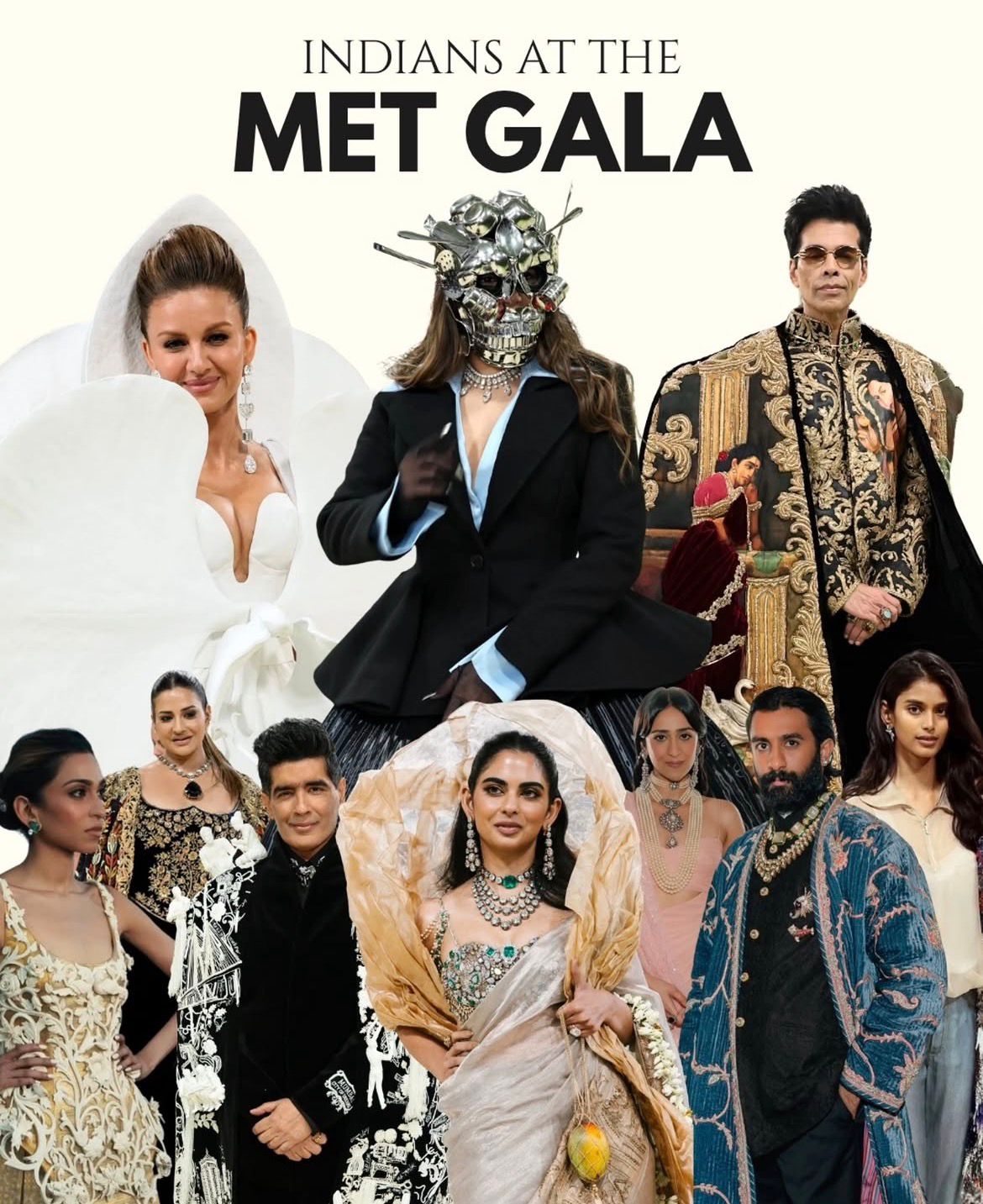
From a saree carrying 1,800 carats of diamonds to a sculptural orchid built by a contemporary artist, the Indian contingent turned this year's "Fashion Is Art" carpet into a working argument for craft, heritage, and the limits of restraint.
The 2026 Met Gala arrived with a brief that should, on paper, have favoured the Indian contingent above almost anyone else. The exhibition was titled "Costume Art," the dress code "Fashion Is Art" — an invitation, essentially, to treat the carpet as a gallery wall. Indian fashion, with its centuries of hand-painted textiles, miniaturist traditions, and embroidery practices that read more like archival pieces than garments, did not have to translate itself for the theme. It only had to show up.
What follows is the breakdown, look by look. Who wore what, who designed it, what it referenced — and, where it earned one, the verdict.
 Isha Ambani · Look 01
Look 01
Isha Ambani
In a custom Gaurav Gupta saree, styled by Anaita Shroff Adajania
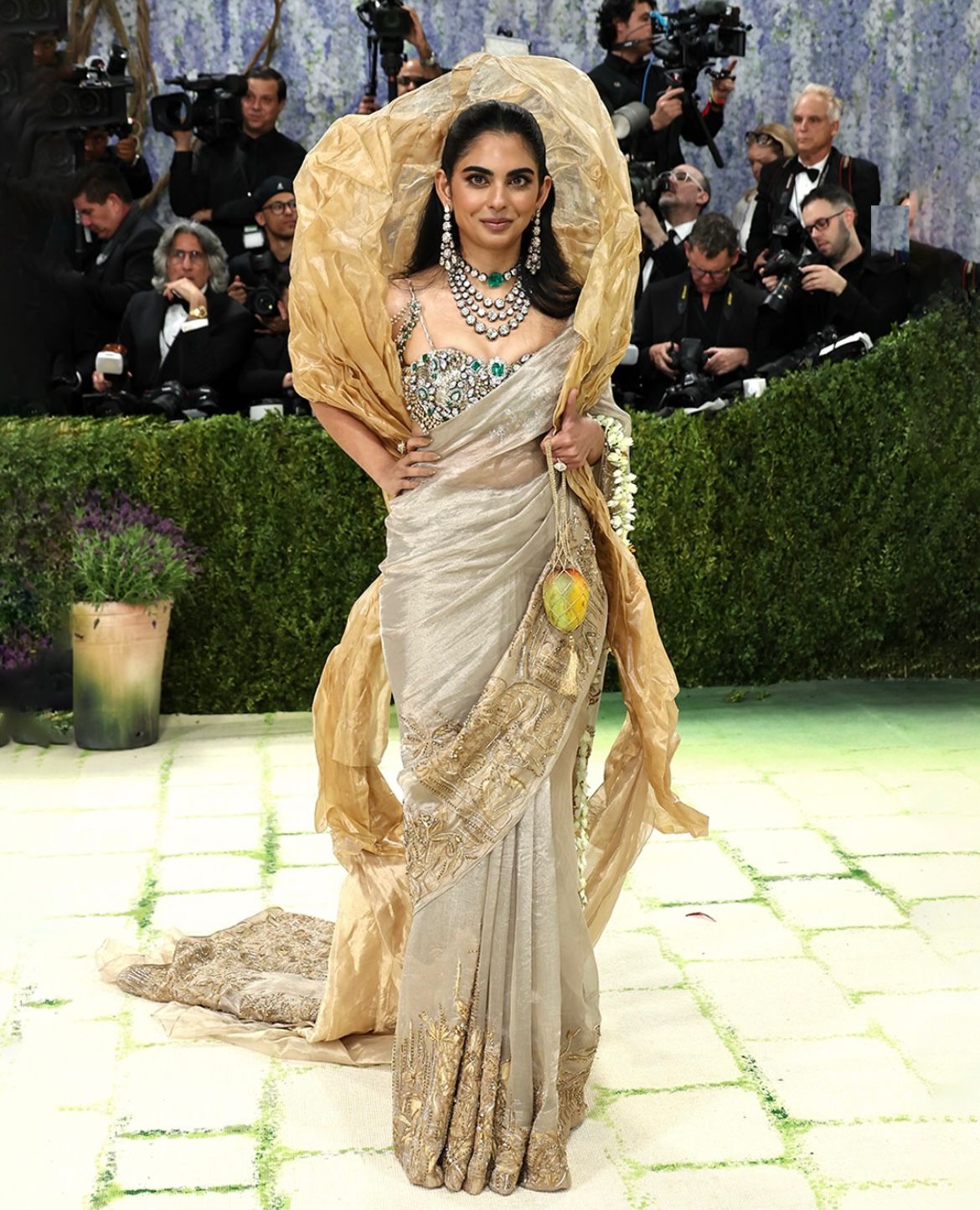
Ambani's look was the night's most literal interpretation of the brief. The sculpted gold saree, designed by Gaurav Gupta, fused a modern silhouette with traditional drape and carried hand-painted Pichwai motifs across its surface — a direct nod to one of India's most enduring devotional art traditions. The bodice was the centrepiece, embellished with over 1,800 carats of diamonds, emeralds, polki and kundan drawn from the family's private collection.
What anchored the look was the editing. A maximalist concept can easily collapse under its own weight; this one didn't. The styling kept the focus on the saree's sculptural fall and the jewellery's depth, with no competing flourishes.
Verdict
Heritage, weighed in carats and conviction.
 Simone Ashley · Look 02
Look 02
Simone Ashley
In custom Stella McCartney
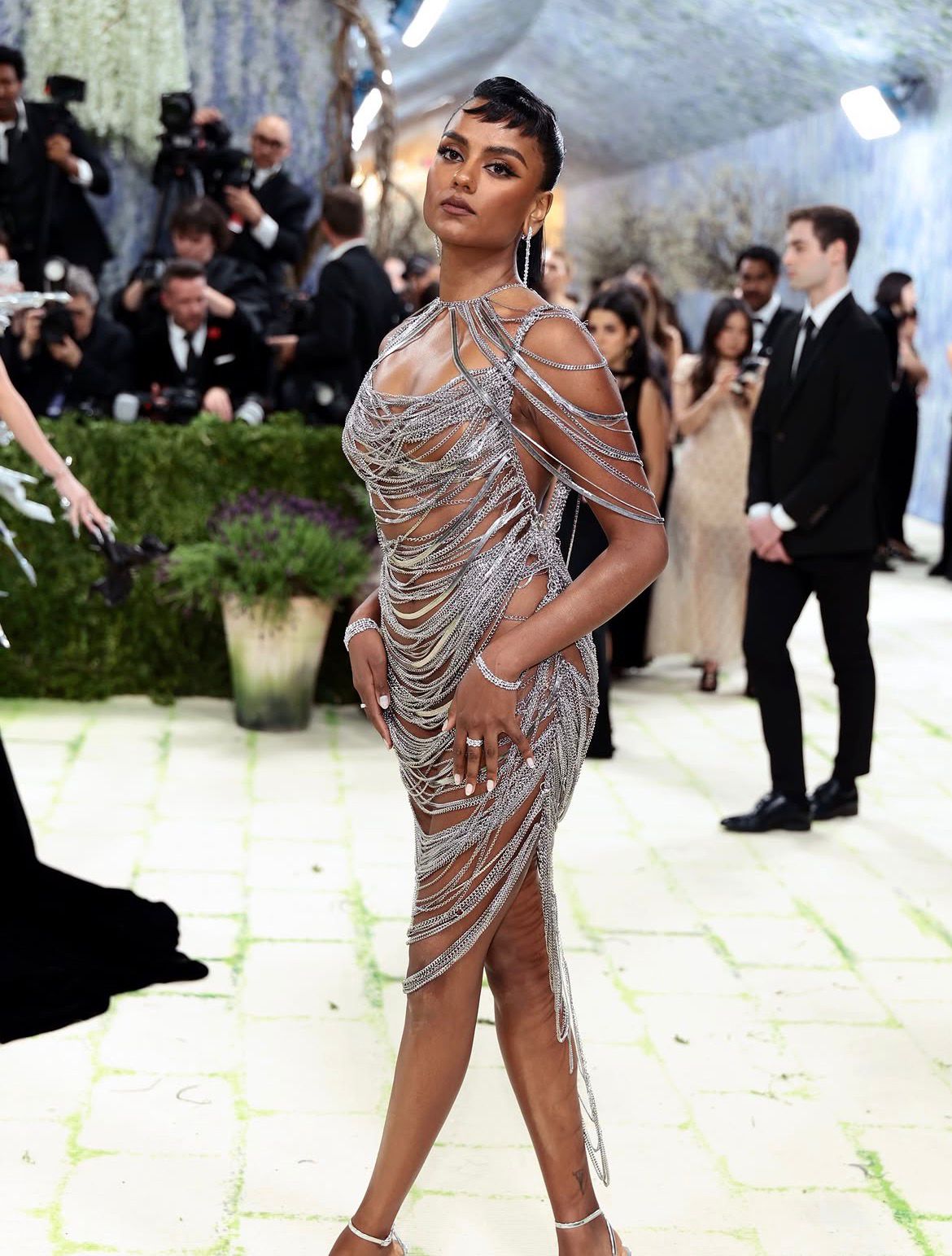
On her third Met outing, Ashley arrived in a "naked look" gown by Stella McCartney constructed entirely from draped silver chains — a piece that read, on first glance, as the simplest thing on the carpet, and on the second, as one of the most technically considered. The chains followed the body without restricting it, catching the flashbulbs in a way that made the silhouette shift with every angle.
For an actor whose previous Met appearances have leaned into colour and silhouette, the choice felt like a deliberate de-escalation. A clean idea, executed with absolute confidence.
Verdict
Restraint as a flex.
 Karan Johar · Look 03
Look 03
Karan Johar
In custom Manish Malhotra
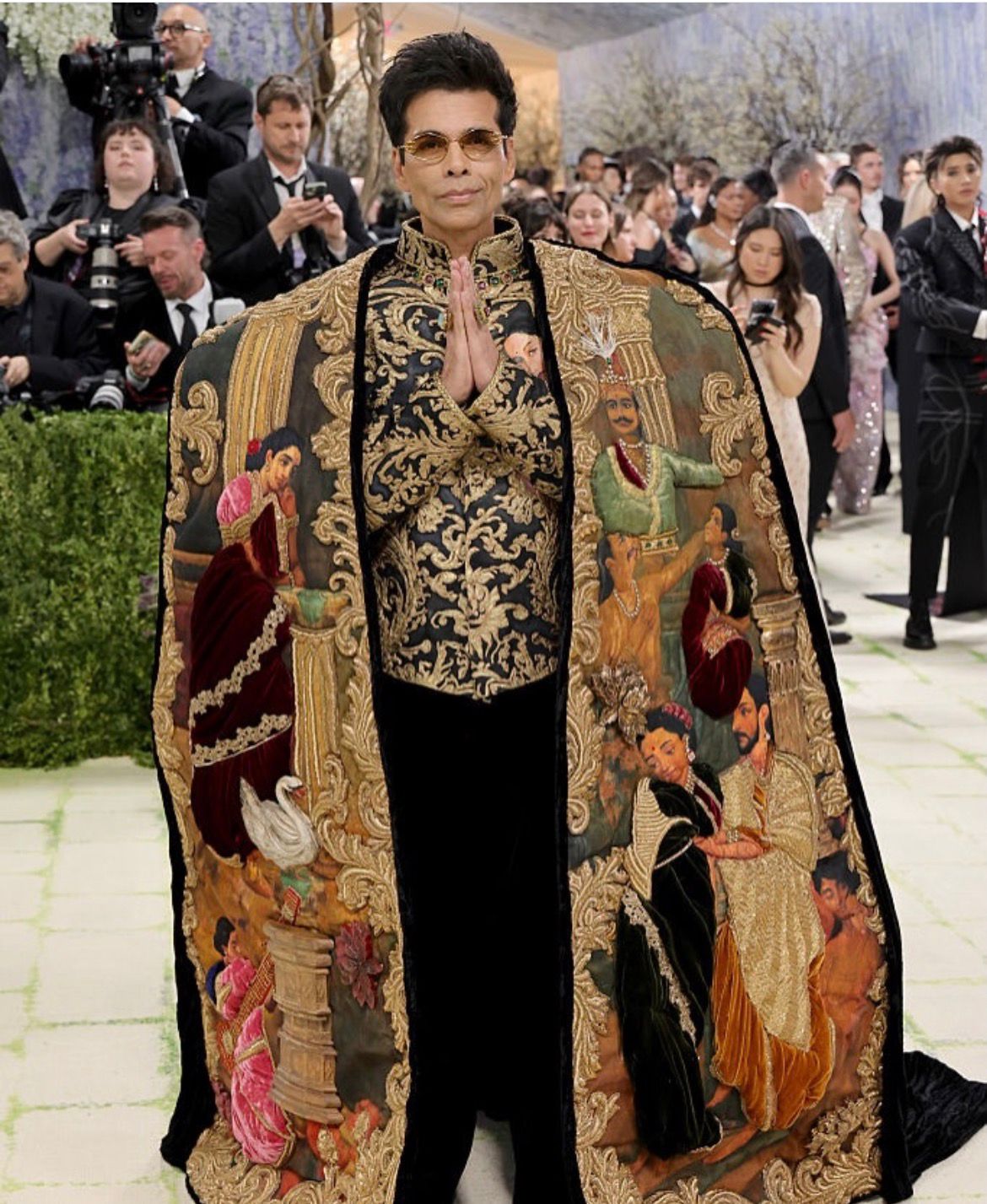
Johar's debut was, in many ways, the loudest argument for Indian craft on the carpet this year. The Manish Malhotra ensemble — a cape, jacket, and trousers — drew directly from the work of Raja Ravi Varma, with hand-painted motifs, traditional zardozi borders, three-dimensional pillar detailing, and embroidered lotuses and swans worked into the piece. The atelier reportedly logged more than 5,600 hours on the look. Even the lining of the jacket was hand-painted.
It was a debut as thesis statement: not Indian fashion translated for an international audience, but Indian fashion presented at full volume and asked to be met on its own terms.
Verdict
A debut that arrived as a manifesto.
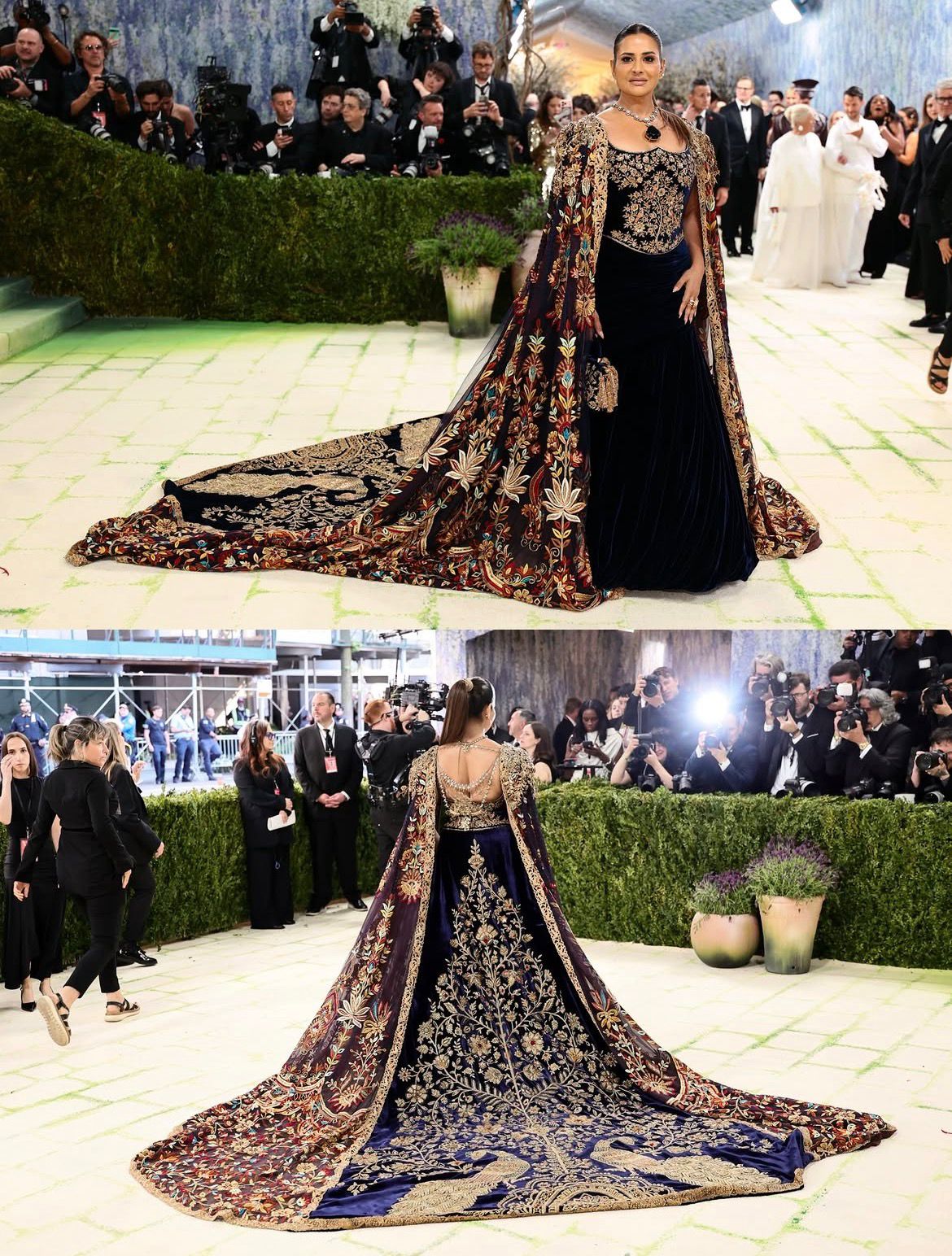 Sudha Reddy · Look 04
Look 04
Sudha Reddy
In custom Manish Malhotra, with personal-collection jewels
Reddy's "Tree of Life" gown, designed by Manish Malhotra, was the result of 3,459 hours of work by ninety artisans. It opened with a royal blue velvet corset embroidered in antique gold, then unfurled into a seven-metre train hand-painted in the Machilipatnam Kalamkari tradition, threading in motifs of Palapitta, Jammi Chettu, Kalpavriksha, Surya and Chandra — a near-encyclopaedic homage to South Indian iconography.
The jewellery, styled by Mariel Haenn and drawn entirely from Reddy's private collection, was the talking point: the "Queen of Merelani," a 550-carat tanzanite, anchored a suite valued at over fifteen million dollars. Maximalism, but built on a clear architectural logic.
Verdict
A regional grammar, scaled up to global volume.
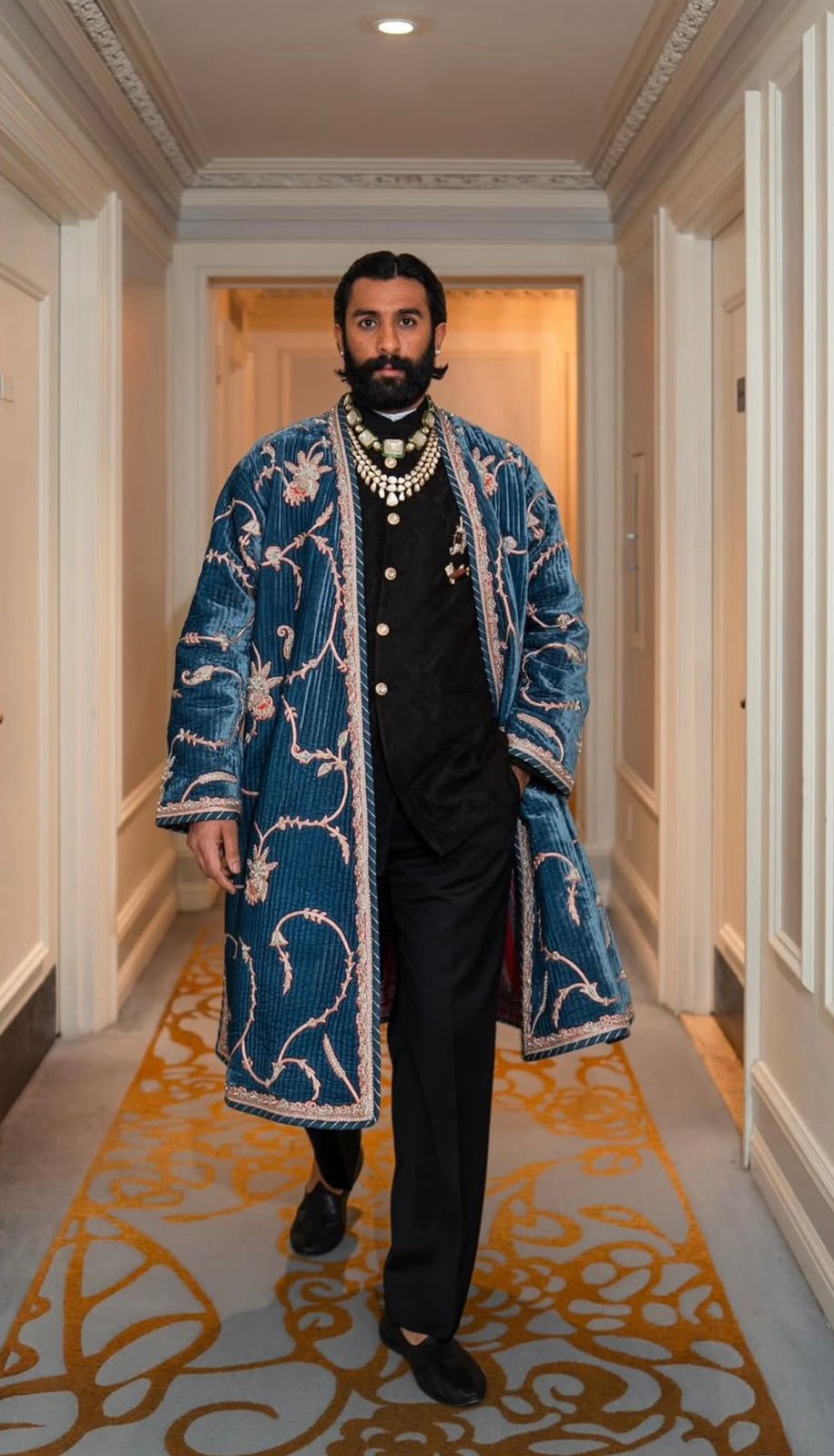 Sawai Padmanabh Singh · Look 05
Look 05
Sawai Padmanabh Singh
In a velvet coat layered over traditional silhouettes
The Maharaja of Jaipur arrived in the look that the rest of the carpet was, in a sense, competing with: heritage worn correctly. A long velvet coat sat over a more traditional silhouette beneath, the layering doing the work of fusing the contemporary cut with the older language he carries naturally. There was no flourish, no statement piece reaching for attention.
The instinct to under-style was the right one. He was photographed alongside his sister, and the two together made one of the cleaner royal images of the night.
Verdict
Inheritance, worn correctly.
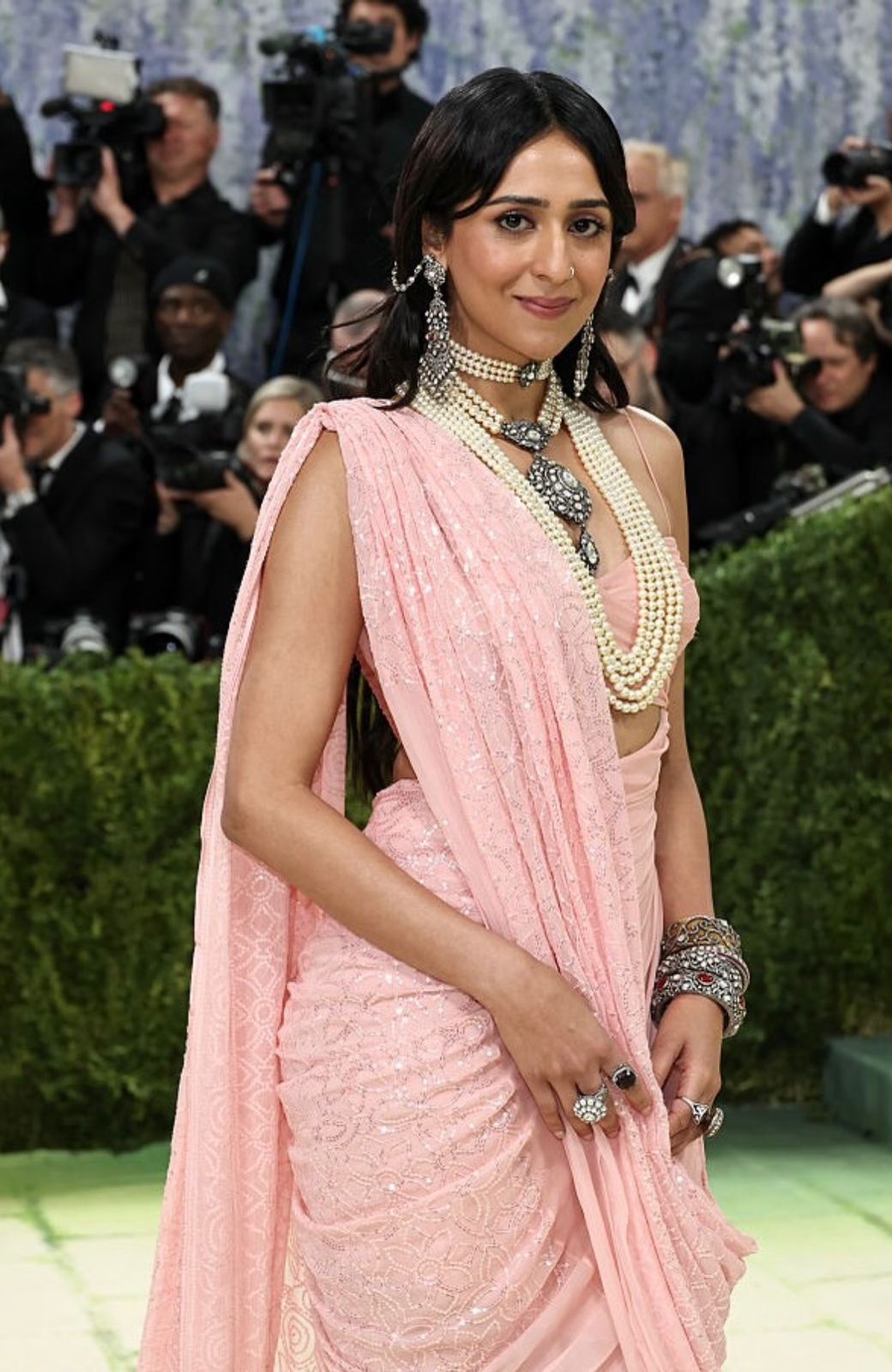 Gauravi Kumari · Look 06
Look 06
Gauravi Kumari
In her grandmother Gayatri Devi's vintage chiffon saree, reworked as a gown
The Princess of Jaipur made her Met debut in a piece that was, in every meaningful sense, an heirloom. She wore her grandmother Gayatri Devi's vintage chiffon saree, transformed for the evening into a fluid gown — a styling decision that preserved the original textile's softness while letting it move as a contemporary silhouette.
The reference was not subtle, but it didn't need to be. Gayatri Devi remains one of the most photographed women of the twentieth century, and walking the Met in her saree was both a tribute and a thesis. Heritage as the actual material of the dress, not merely its inspiration.
Verdict
A debut handled with poise.
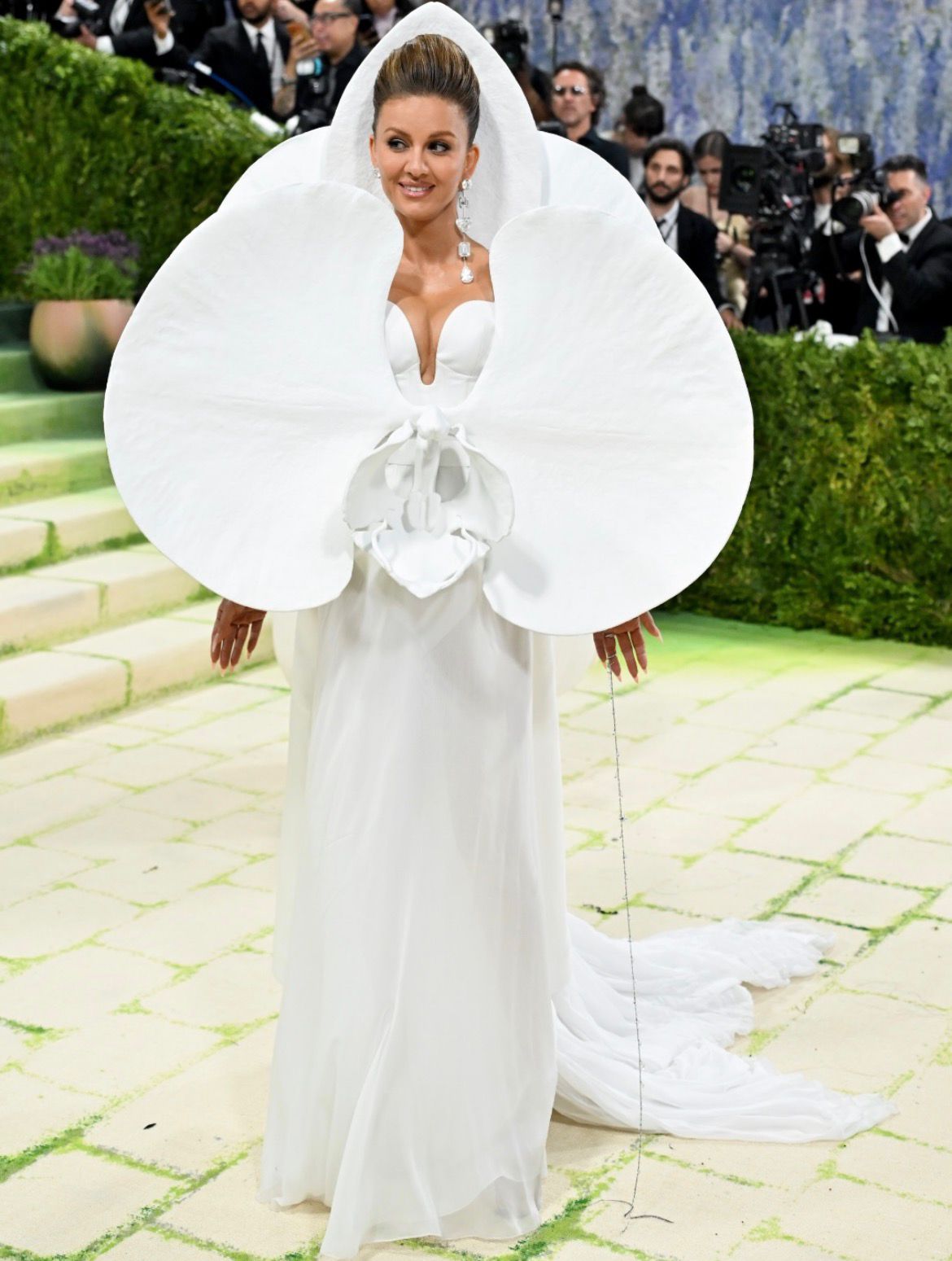 Natasha Poonawalla · Look 07
Look 07
Natasha Poonawalla
In a Marc Quinn sculpture with Dolce & Gabbana couture
If anyone took the "Fashion Is Art" brief literally, it was Poonawalla. The centrepiece of her look was the Orchid Pectoral, a sculptural piece by British artist Marc Quinn, designed specifically for her in lightweight high-tech materials and worn across the chest like an actual flower opening outward. Quinn described the piece as one that only fully comes alive when worn, with the body activating it rather than the plinth.
The Dolce & Gabbana couture beneath, crafted by the Alta Moda team, anchored the sculpture without competing with it. The effect was less an outfit than a deliberate collaboration between artist, wearer, and atelier — the closest thing the carpet had to a performance piece.
Verdict
Living art, exactly as the theme intended.
 Manish Malhotra · Look 08
Look 08
Manish Malhotra
In a self-designed bandhgala with a sculptural cape
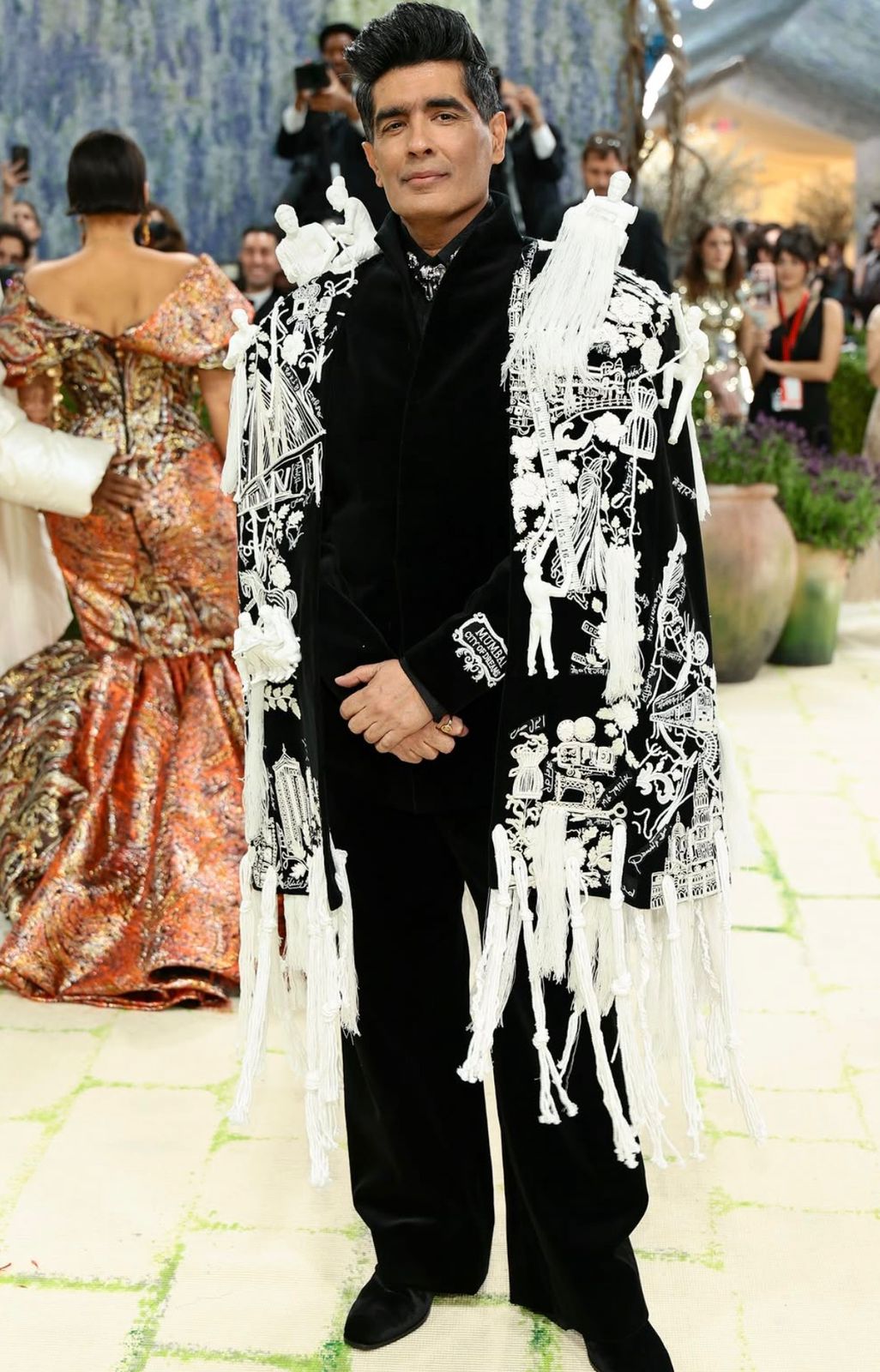
The designer dressed three of the night's most-photographed women, but his own look was the quietest tribute on the carpet. The self-designed bandhgala was layered with a cape embroidered with the names of his Mumbai artisans — the people who had built the pieces he was sending down the steps. Architectural references to the Taj Mahal Palace Hotel, the Gateway of India, and Chhatrapati Shivaji Terminus ran through the embellishment, alongside motifs nodding to the city's trains and taxis.
He carried a measuring tape draped at the neck, a deliberate gesture toward the workshop. The look was, in effect, a moving credit line — Malhotra refusing to separate the designer from the people behind the design.
Verdict
The designer as a love letter to his workshop.
 Ananya Birla · Look 09
Look 09
Ananya Birla
In custom Robert Wun couture, with a sculptural mask
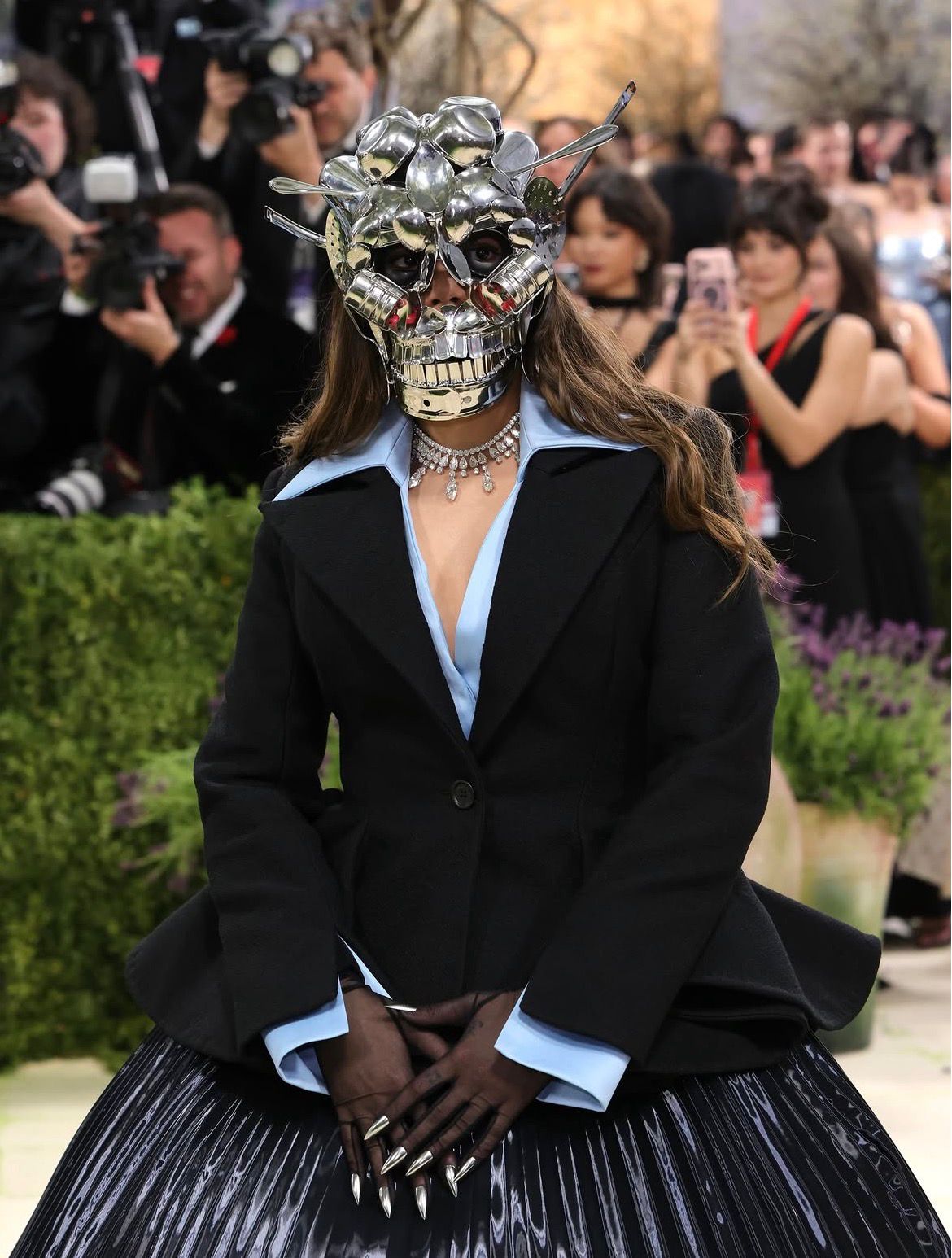
Birla's debut was easily the most discussed Indian arrival outside the established names — a custom Robert Wun couture look completed with a sculptural mask that read, depending on the angle, as either avant-garde sculpture or something closer to surrealist tableau. The internet, predictably, dissected the mask within minutes; the more serious read was that Birla had used her first Met appearance to make a deliberate, art-forward statement rather than a safe heritage play.
That she changed into a separate Harris Reed demi-couture look for the GQ after-party — a structured corset inspired by an M.F. Husain painting from her family's personal collection — only reinforced the night's argument. Birla treated the evening as a sustained piece of curation, not a single arrival.
Verdict
A debut that refused to play it safe.
 Diya Mehta Jatia · Look 10
Look 10
Diya Mehta Jatia
In custom Mayyur Girotra
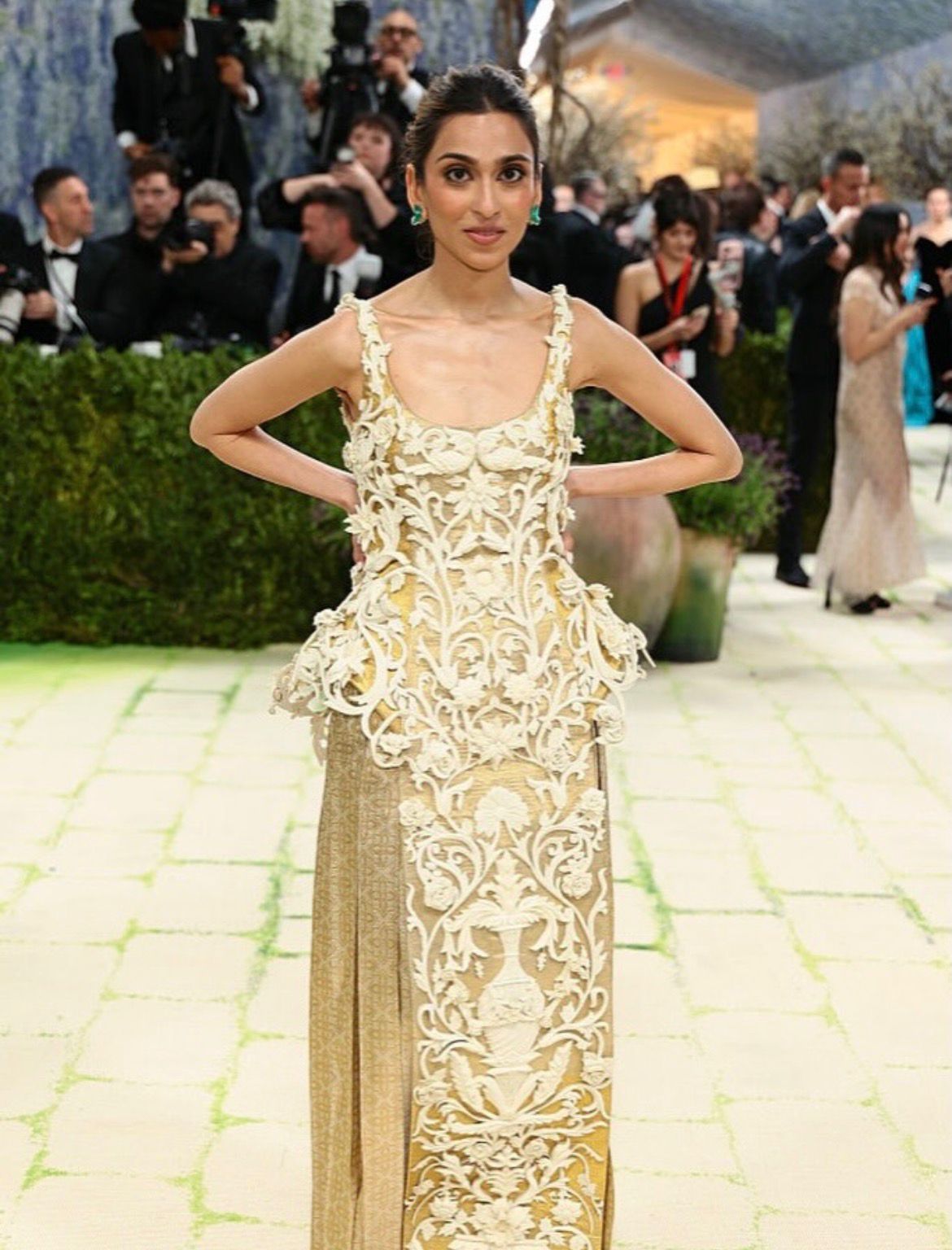
The fashion consultant's debut was the look most explicitly built around a single craft tradition. The Mayyur Girotra ensemble was designed as what she described as a hardcore India story, structured around Shola — the endangered pith-craft tradition from West Bengal, in which the soft inner core of the shola plant is hand-shaped into intricate sculptural detailing.
Most of the carpet's craft references this year were nationally familiar. This one was deliberately not. Choosing a regional, endangered tradition for a Met debut was the kind of bet that only works if the work itself can carry the weight, and here it did.
Verdict
A regional craft, handed the loudest stage available.
 Bhavitha Mandava · Look 11
Look 11
Bhavitha Mandava
In Chanel
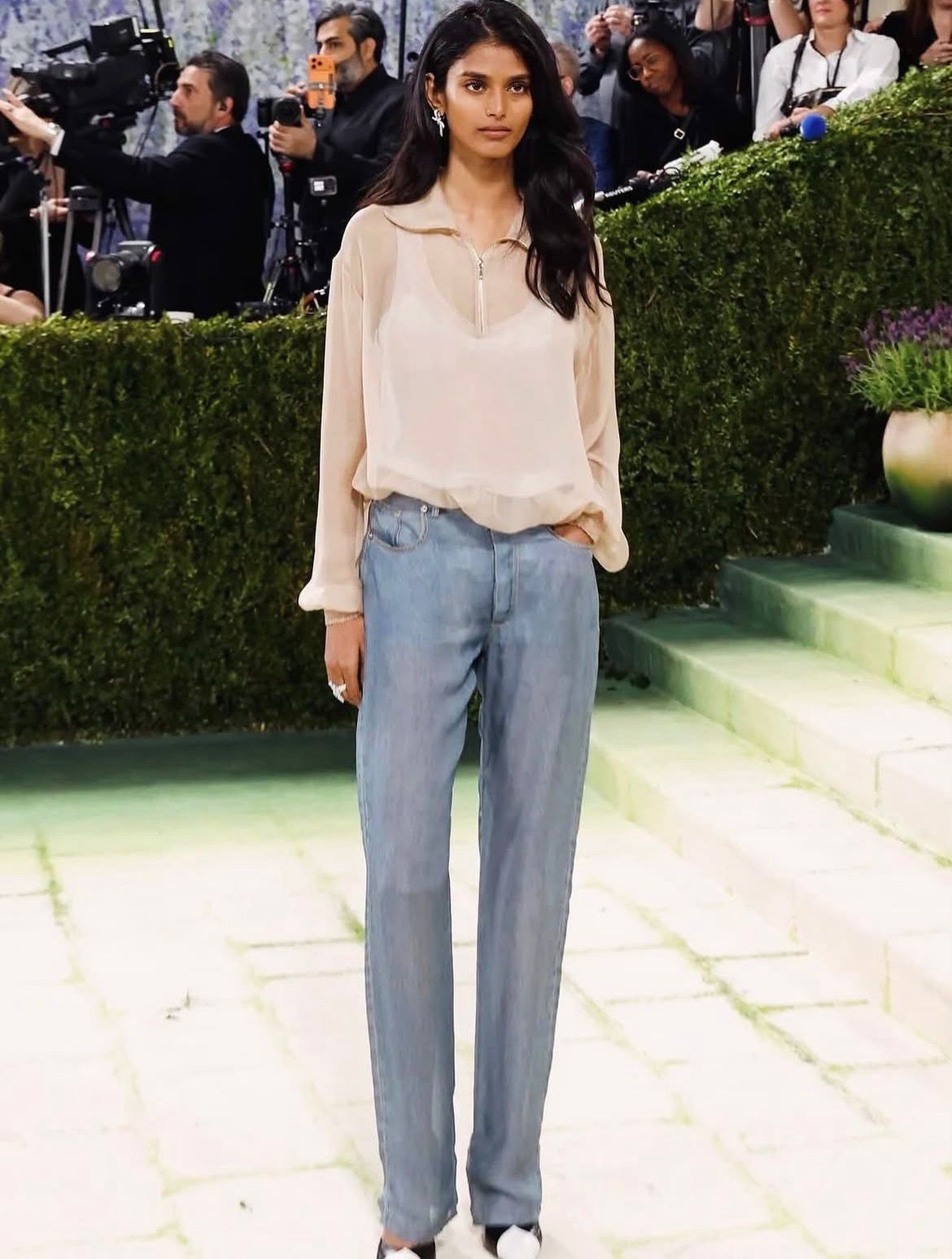
Mandava's debut was, on first viewing, the most polarising look the Indian contingent put forward — a Chanel ensemble that read, to a casual eye, as a jeans-and-top combination on a carpet built for spectacle. The discourse online was instant and unkind. The actual construction was more interesting: a trompe-l'oeil couture piece engineered to look casual, with the denim and the top both built from embellishment-grade fabrics designed to mimic something deliberately ordinary.
Read against the theme — fashion as art — the gesture was sharper than the social-media response suggested. Mandava framed it as a tribute to her own journey in the industry. A debut that knew exactly what it was doing, even when the room briefly didn't.
Verdict
A debut sharper than its first read.
"If there was a through-line this year, it was that the Indian contingent had stopped translating themselves. Nobody on those steps was explaining their references."
Eleven looks, eleven different conversations with the carpet. What was striking, taken together, was how little of the evening was spent in translation. A decade ago, an Indian designer at the Met was a footnote; five years ago, a curiosity; this year, a working assumption. The steps absorbed sarees, sherwanis, Kalamkari, Pichwai, Shola, vintage chiffon, and one full sculptural pectoral without anyone pausing to caption them.
That shift — from explanation to fluency — is the actual story. The clothes were extraordinary, but extraordinary clothes have always shown up. What's new is the confidence with which they arrived, and the equally striking confidence with which the room received them.
Next year's theme has not yet been announced. On the available evidence, the Indian contingent will be ready before the rest of us.
Key takeaways
- 11 Indian looks decoded
- Designers, jewels & references
- Editor's verdict on each